
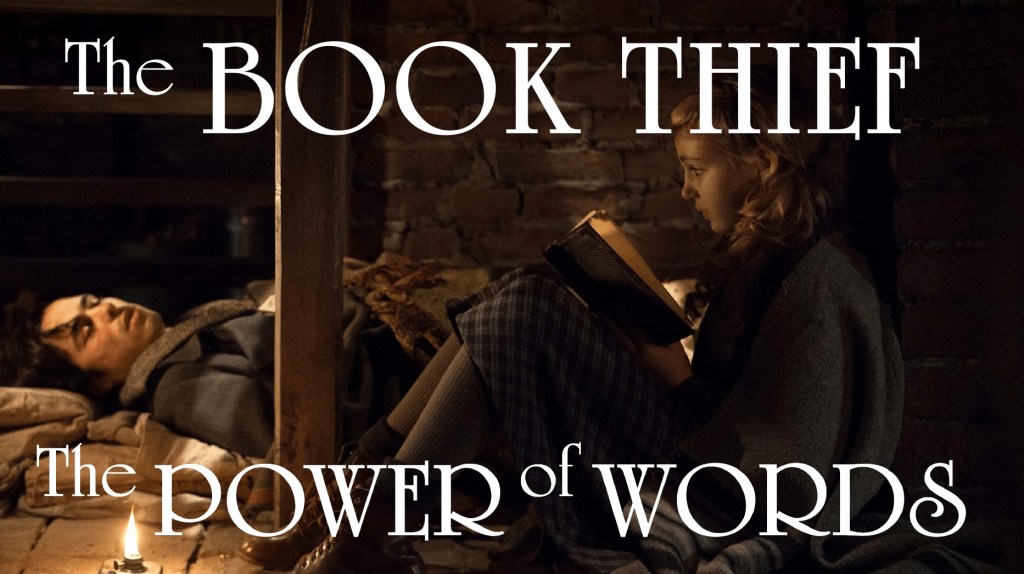
I’ve taught Markus Zusak’s The Book Thief for many years. It’s a book that is so easy to love, and one that admittedly walks the line between young adult fiction and more “serious” literature. The Book Thief’s central theme — “the power of words” — also might not seem all that complex. But the more intimately I’ve gotten to know this story, the more I’ve grown to appreciate Zusak’s storytelling. He takes this simple theme and weaves it into veritably every aspect of the narrative — the characters and their relationships, the historical context, and the plot. This was how he summarized the book after all. To explore this in more detail, let’s look at both the novel and the 2013 film adaptation.
The Book Thief novel is a frame story, narrated by the force of Death himself. At the beginning, Death tells us that the story of Liesel Meminger is a result of him discovering this young girl’s written memoir — fittingly called The Book Thief — in a garbage truck. So right from the start, the telling of this story is sparked not only by Death being drawn to Liesel’s survivor spirit, but also to her writing, rescuing her words from otherwise being forgotten.
Once the narrative starts, the first instance of book thievery occurs. Liesel, in an irrational act next to the fresh grave of her younger brother, steals a handbook on how to dig graves. This is a perfect inciting incident both for the motif of stealing books and for the introduction of Liesel’s coming-of-age journey. She is now forced to navigate moving past the trauma of losing her brother and mother — to metaphorically “dig their graves” — and build her own identity.
We also see the power of words in Liesel’s early stages of her maturing process when she arrives at her new school. She is bullied for her inability to write her name. Her personal immaturity parallels her immaturity with words. Thus, when her words fail her, she feels forced to resort to violence.

It’s no coincidence, then, that her new Papa, Hans, who provides the love and security she needs for personal growth, uses words to do so. He comforts her with kindness and uses the act of teaching Liesel to read as a way of connecting with her and helping her along the road to maturity and identity.
Words are also at the center of Liesel’s other close relationships. The Mayor’s wife Isla’s small act of allowing Liesel to read books in her library paves the way for their mutual and eventually life-saving relationship. Rudy rescues Liesel’s book from the river, displaying the sort of innocent and selfless love they share. Liesel and Max are connected by their isolation and their unfavorable status in the eyes of the Nazis, but it is through their mutual love of words that their friendship truly blossoms.
Apart from Liesel herself, the power of words is an integral part of the story’s historical backdrop as well. We see propagandistic language marked by hate and discrimination from the Nazis. And Max’s fairy tale he makes for Liesel called “The Word Shaker,” depicts Hitler using words as his primary tool used to take over the world
Within this historical backdrop, we see these two marginalized figures — a runaway Jew and the orphan daughter of a communist — take subversive action through words. Like Rudy rescuing her book from the river, Liesel literally rescues words from the fires of Nazi censorship and finds life and hope in these books. Max subvertly uses Hitler’s writing within the pages on Mein Kampf first as a way to hide and blend in on the run. Then, he paints over Hitler’s hateful words in a cleansing white, making pictures and books as gifts of kindness for Liesel. I love this part in the novel: “There were the erased pages of Mein Kampf, gagging, suffocating under the paint.” As Zusak said, they are stealing back the power of words from Hitler.
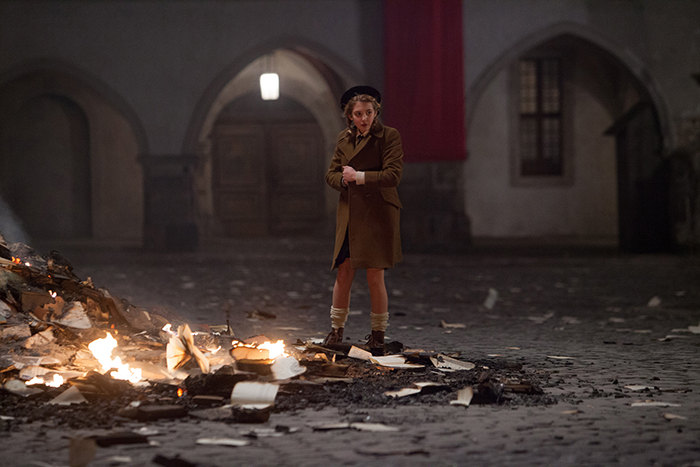
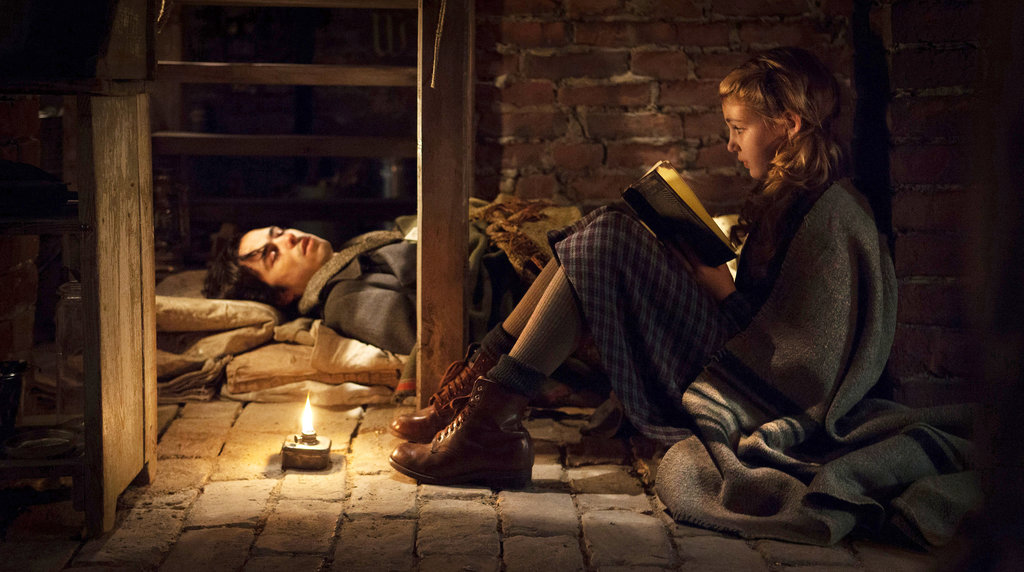
As the story drives on, Liesel steals more books, many of which in the novel share direct links to her conflicts and state of mind. Eventually, the Nazis nearly strip away all of Liesel’s closest connections. Yet along the way, we see Liesel growing in confidence and maturity, which is again illuminated by her use of language. Just as Hans used words to comfort Liesel at the start, Liesel goes on to do the same for Max when he is sick. She goes from being a bullied, illiterate girl to a confident reader, who even reads stories aloud to comfort others in the bomb shelter.
Then we arrive at the heart-wrenching ending, which always leaves very few dry eyes in my classroom. Despite the horror of the bombing, as hell is brought to Heaven Street and Liesel’s world is turned upside down, it turns out that the act of her writing in the basement — finishing The Book Thief — is what actually protected her from the bombs. As Death says when he observes her among the wreckage, “She was holding desperately on to the words who had saved her life.” Words — the very thing that inspired the Nazis and perhaps the war as a whole — have been with her throughout her entire journey and actually end up saving her life, in more ways than one perhaps.
As Death completes the frame story in the novel, he recalls Liesel’s final lines of The Book Thief, which connect well to the story’s other central theme of the strange, dual-natured capacity of humans: “I have hated the words and I have loved them, and I hope I have made them right.”
The film hints at this at the end as well, in a creative divergence from the book. As the camera passes over the belongings of Liesel at the end of her life, we see a literary award and stacks of books said to be authored by Liesel Meminger — suggesting that she has gone on to pursue an adult life and career defined by the power of words
So despite the seeming simplicity of the theme, “the power of words,” it works on so many levels. 1.) It is vital to Liesel’s characterization and her coming-of-age arc. 2.) It is a part of the meaningful connections between most major characters. 3.) It is key to the historical backdrop and the historical commentary the story provides. 4.) And its importance to the plot’s central conflicts and resolutions drive it home as a universal truth with wide-reaching implications.



 Mark Cooprider
Leave a reply to Saureesh Cancel reply